IoT Development
IoT Systems That Connect Software to the Real World
IoT is where software moves beyond screens and begins interacting directly with physical systems.
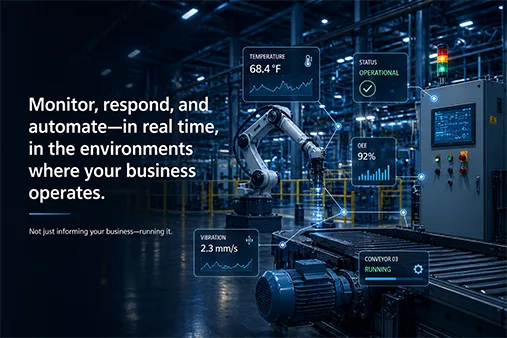
IoT Systems That Connect Software to the Real World
IoT is where software moves beyond screens and begins interacting directly with physical systems. We build systems that sense, measure, and act—bringing real-world operations into your software stack.
IoT systems collect real-world data, respond to changing conditions, and automate physical processes —extending your software beyond the desktop, mobile device, or browser.
These systems operate inside equipment, across facilities, and in remote environments —continuously capturing information and acting on it in real time.
At a systems level, IoT creates a continuous feedback loop between the physical world and your software. Data is captured at the edge, transmitted reliably, processed in real time, and translated into decisions—either informing users or triggering immediate action.
This closes the gap between what is happening and what your systems know—eliminating delays, reducing manual reporting, and enabling decisions to be made with current, accurate information.
The result is greater visibility, faster response, and tighter control over the systems your business depends on.
Where IoT Delivers Value
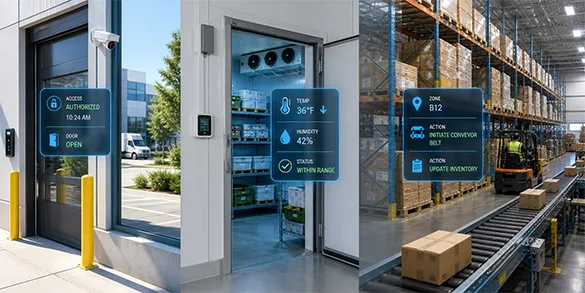
IoT is most effective in environments where continuous monitoring and automated responses are required.
Where IoT Delivers Value
IoT is most effective in environments where continuous monitoring and automated responses are required.
These systems operate reliably in locations where human interaction is limited or inefficient—industrial equipment, remote sites, warehouses, facilities, and infrastructure.
Common use cases include:
- Environmental monitoring (temperature, humidity, air quality)
- Equipment status and predictive maintenance
- Access control and security systems
- Energy usage tracking and optimization
- Event-driven automation and alerting
In these scenarios, IoT provides continuous awareness and immediate response—without requiring constant human oversight.
Sensing the Physical World
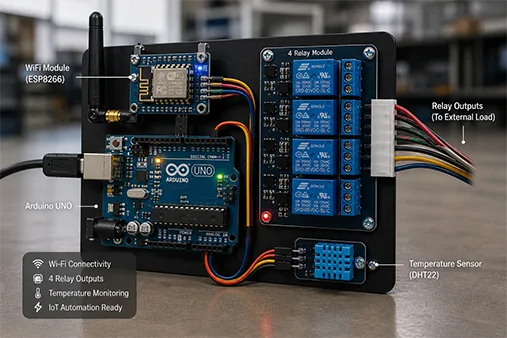
IoT systems are built around modular sensing—devices are configured to capture only the data required for their specific role.
Sensing the Physical World
IoT systems are built around modular sensing—devices are configured to capture only the data required for their specific role.
This selective approach reduces complexity, lowers power consumption, and improves long-term reliability.
Sensors can be tailored to measure temperature, motion, pressure, vibration, electrical current, location, and environmental conditions—depending on the needs of the system.
By focusing only on relevant signals, IoT devices deliver precise, actionable data without unnecessary overhead.
Acting on Real-World Conditions
IoT systems don’t just observe—they act.
Acting on Real-World Conditions
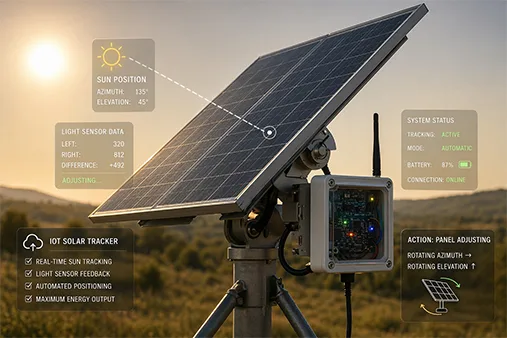
IoT systems don’t just observe—they act.
Sensor data is evaluated in real time and translated directly into physical responses—activating equipment, adjusting environmental controls, or rerouting processes as conditions change.
These systems operate as closed loops, where detection, decision, and action occur continuously without delay.
The result is faster response, reduced manual intervention, and systems that adapt automatically to the environment they operate in.
Built for Reliability
We design IoT systems using hardware and communication protocols appropriate to the environment and reliability requirements.
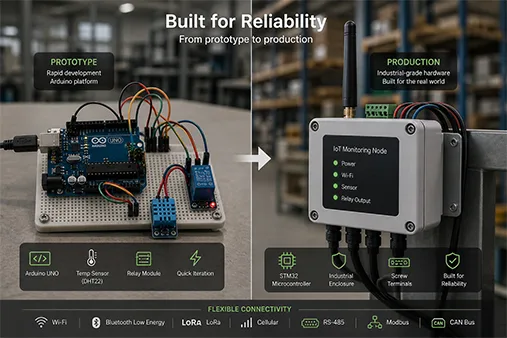
Built for Reliability
We design IoT systems using hardware and communication protocols appropriate to the environment and reliability requirements.
For rapid prototyping, we use platforms such as Arduino to validate concepts quickly. For production systems, we transition to industrial-grade hardware such as STM32 microcontrollers and other embedded platforms.
We work across a range of connectivity options including Wi-Fi, Bluetooth Low Energy, LoRa, cellular, and industrial protocols such as RS-485, Modbus, and CAN bus.
These systems integrate directly with APIs, mobile applications, and web platforms—forming a complete pipeline from sensor to system to decision.
Part of a Full Stack System
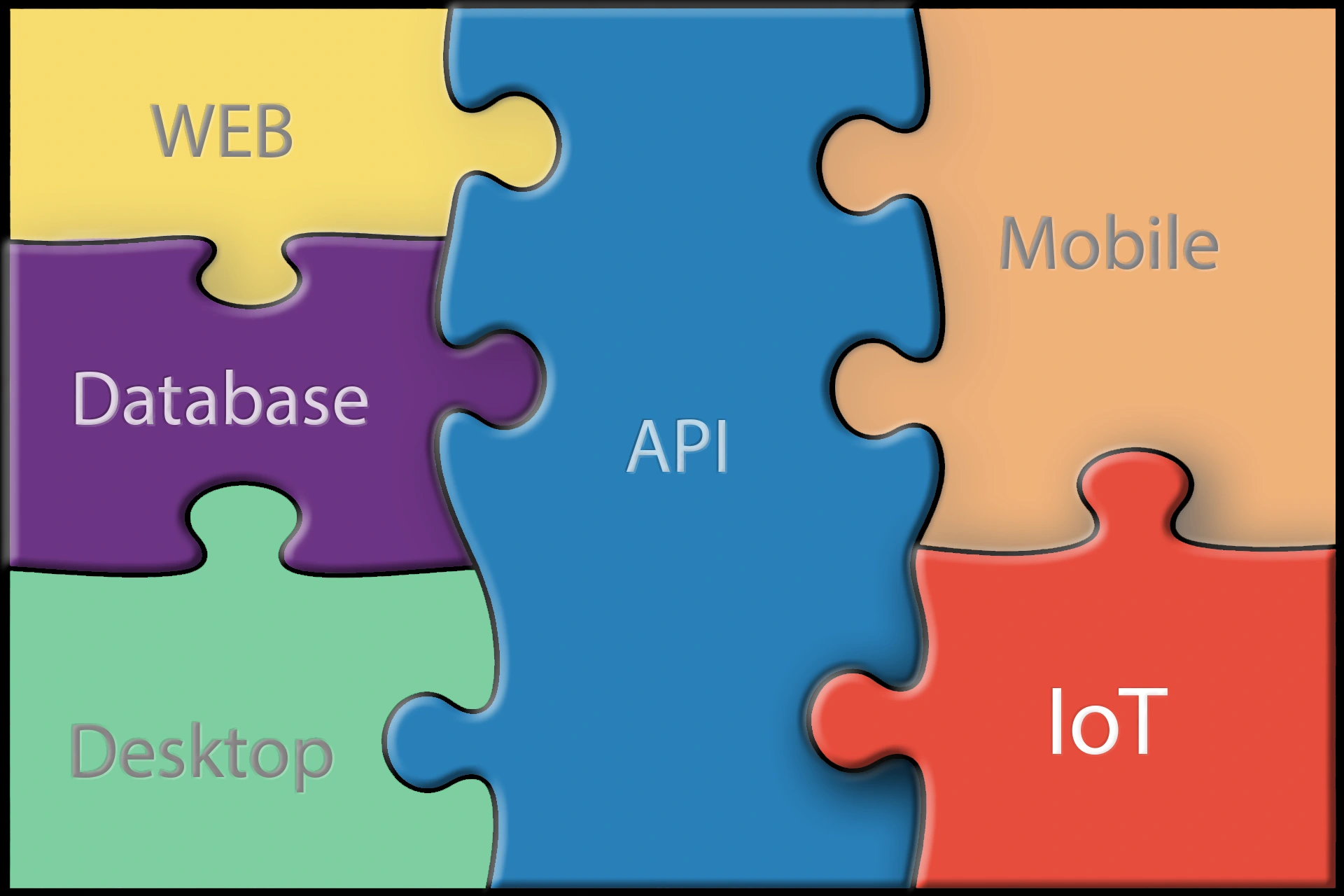
Part of a Full-Stack System
IoT systems extend your software into the physical world—capturing and acting on real-world conditions in real time:
- IoT — senses conditions and triggers actions in physical systems
- API — processes, secures, and routes data between systems
- Database — stores, validates, and maintains a consistent source of truth
- Web — provides visibility, monitoring, and decision-making interfaces
- Desktop — supports operational control and high-efficiency workflows
- Mobile — enables field interaction and real-time response
Together, these layers create a closed-loop system where real-world events are captured, processed, and acted on without delay.
Connect Your Systems to the Real World
If your organization needs better visibility, automation, or control over physical operations, we can design IoT systems that integrate cleanly with your existing software.
Let’s build what your business needs next