Database Engineering
Fix Your Data. Fix Your Business.
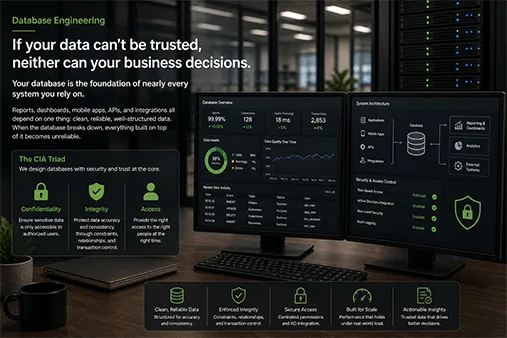
Your database contains everything — orders, billing, scheduling, reporting, operations. When the data inside it is wrong, slow, or inconsistent, the entire business feels it.
Fix Your Data. Fix Your Business.
Your database contains everything — orders, billing, scheduling, reporting, operations. When the data inside it is wrong, slow, or inconsistent, the entire business feels it.
If your data isn’t accurate and consistent, it creates friction across your entire business — bad reports, manual fixes, and systems you can’t fully trust. Those small issues add up: delays, rework, uncertainty, and decisions made on numbers that don’t always agree.
Many SMBs know their database contains ALL the information they need — they just can’t access it from the software sitting on top of it. We remove that barrier. We build the tools, integrations, and data pathways that finally unlock the information your business has been storing for years. When you can reach the data directly, you stop working around limitations and start using the full power of the system you already own.
Unlock the Data Inside Your System
We don’t replace systems blindly. We extend them—carefully, deliberately, and with a clear path forward.
Unlock the Data Inside Your System
We don’t replace systems blindly. We extend them—carefully, deliberately, and with a clear path forward.
Many businesses rely on legacy or proprietary systems that still run critical operations—but limit growth, reporting, and integration.
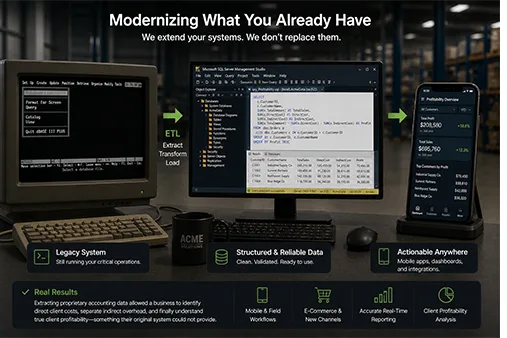
On more than one occasion, gaining direct access to a system’s database has breathed new life into a company’s existing software. Instead of replacing a legacy accounting platform with a full ERP just to support extra functionality — like mobile or online orders — we extend the system they already trust. Unlocking the data opens the door to new capabilities without disrupting the core operations that still work.
Using ETL (Extract, Transform, Load), we pull data out of those systems and make it usable across your business — giving you capabilities your existing software could never deliver on its own. This allows you to:
- enable mobile applications and field workflows
- expand into e-commerce and new sales channels
- generate accurate, real-time reporting
- analyze profitability at the client level
- analyze true cost and performance at the vendor level
Data Integrity Isn’t Optional
If a system allows bad data, it’s not just a user problem—it’s an engineering problem.
Data Integrity Isn’t Optional
If a system allows bad data, it’s not just a user problem—it’s an engineering problem.
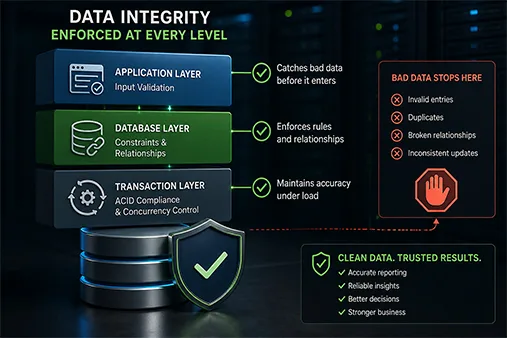
In the CIA triad (Confidentiality, Integrity, Availability), integrity is the foundation. Without it, the other two don’t matter. In fact, accessing a database with low integrity can be more harmful than not accessing it at all — because decisions made on corrupted or inconsistent data create real operational and financial risk.
Data integrity is enforced at multiple levels:
- validation — preventing bad data before it enters the system
- database constraints and relationships — enforcing structure and consistency at the source
- transaction control for high‑volume systems — ensuring accuracy when many operations happen at once
When these layers aren’t aligned, data becomes inconsistent, reporting becomes unreliable, and trust in the system erodes.
We design systems where creating bad data is exceptionally difficult — and where the data you access is data you can rely on.
Our Engineering Approach
We build systems that stay fast, stay accurate, and stay easy to work with — so your business never gets boxed in by technical decisions made years ago.
Our Engineering Approach
We build systems that stay fast, stay accurate, and stay easy to work with — so your business never gets boxed in by technical decisions made years ago.
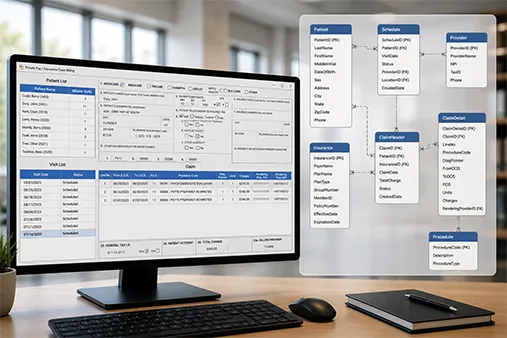
Most SMBs don’t need complex systems — they need systems that stay fast, stay clean, and stay flexible as the business grows. We engineer databases and applications with that in mind: clear structures, consistent rules, and data pathways that stay reliable over time.
We get maximum performance while maintaining strong data constraints, but we also avoid the trap of over‑engineering. Too many data constraints make a system rigid. Too much performance tuning makes it fragile. Too much flexibility makes it inconsistent. Any one taken to an extreme paints you into a corner with the other two. The real engineering skill is creating a system that gives you all three without letting any one dominate.
That’s why we use controlled data access and stored procedures to keep business logic consistent and ensure the system behaves the same way every time. This approach enables fine‑grained security, protects against SQL injection and similar attack vectors, and maintains performance even under heavy load.
Depth of Experience
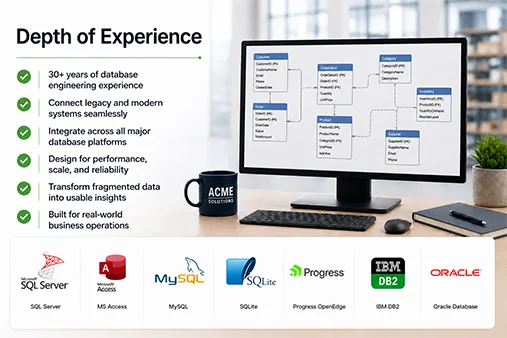
We’ve worked with every generation of database technology — which means we can modernize what you have without forcing you to start over.
Depth of Experience
We’ve worked with every generation of database technology — which means we can modernize what you have without forcing you to start over.
After thirty years of building and rescuing business systems, we’ve worked across every generation of database technology. From early tools like dBASE III and Microsoft Access, through SQLite, MySQL, and every major version of SQL Server, to enterprise engines like Oracle and DB2 powering large‑scale ETL workflows — we’ve built, tuned, extended, and modernized them all. That breadth means we understand not just the technology, but the eras, constraints, and business realities each platform came from.
Over the decades, that experience has saved businesses millions of dollars in avoided upgrades, unnecessary rewrites, and steep training curves. We know how to bridge old and new systems, integrate platforms that were never designed to talk to each other, and design solutions that evolve with your business instead of disrupting it. After three decades, one thing has stayed true: the right engineering doesn’t just fix today’s problem — it protects tomorrow’s momentum.
Part of a Full Stack System
Part of a Full Stack System
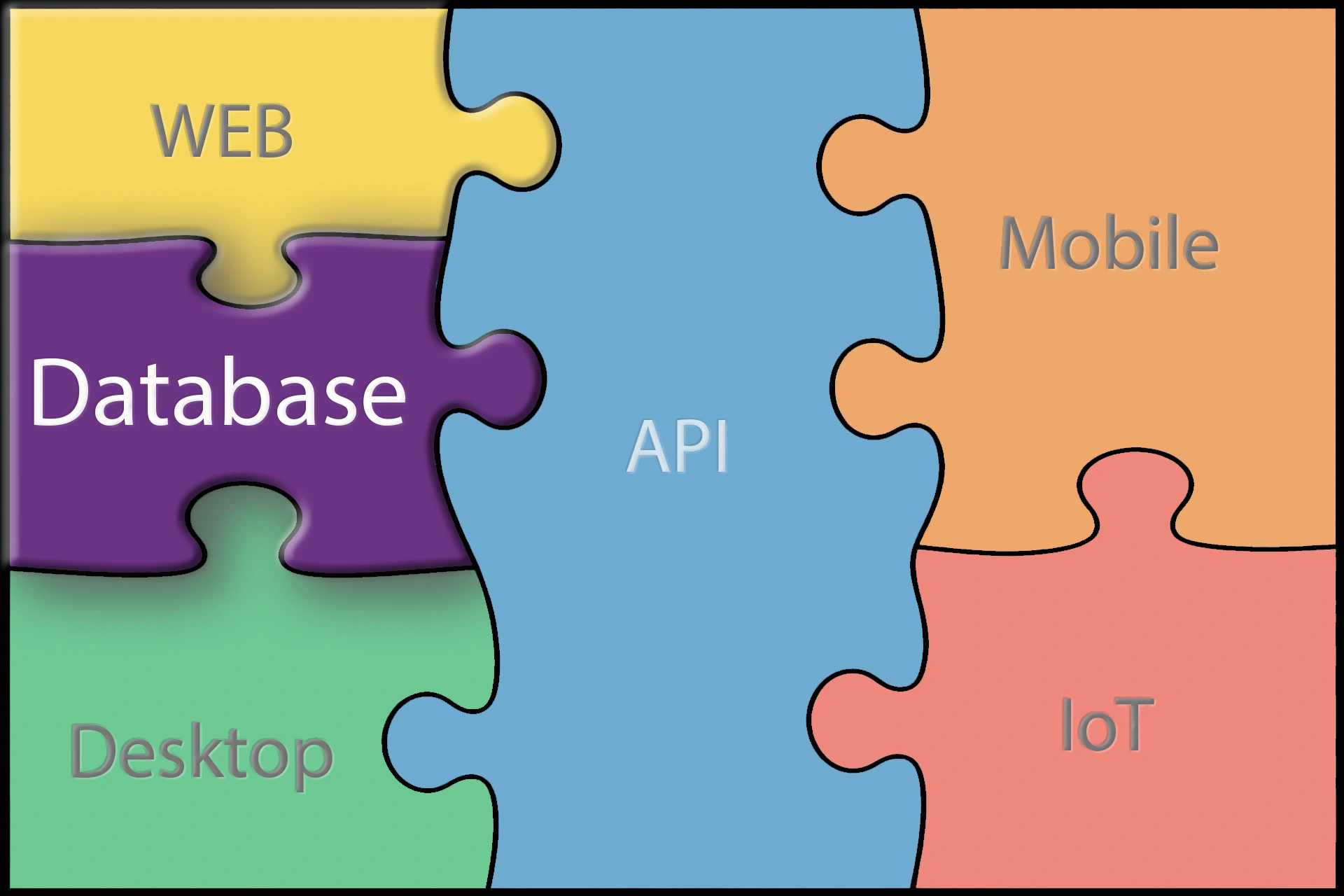
The database is the foundation of a complete system:
- Database — central source of truth, ensuring data integrity, consistency, and long-term reliability
- API — controlled access layer that moves and secures data between systems
- Web — delivers structured data for visibility, interaction, and decision-making
- Desktop — handles high-volume processing and operational workflows
- Mobile — captures and consumes data in real-world environments
- IoT — generates real-time data from physical systems and devices
Together, these layers create a connected system where real-world events flow directly into business processes and decision-making.
Let’s Build a System You Can Trust
If your organization depends on accurate data, reliable reporting, and systems that scale, we’re ready to help.
Let’s build what your business needs next